
Last updated October 17, 2026
 Metal roofing
 Architectural shingles
 Tile roofing
 GAF
GAF Owens Corning
 Flat & low-slope
Free roof inspection with deck photos before we talk money - GAF and Owens Corning certified installation
Roofing Warning Signs: A Dallas Homeowner’s Reference Guide
A dark stain on your ceiling and a dark stain on your fascia board can have completely different causes, different urgency levels, and different repair costs. Treating them the same way is how a $400 fix becomes a $4,000 fix. This guide explains what each warning sign means mechanically, which ones demand immediate action versus which ones you can watch, and why certain signs appear faster on Dallas roofs than they do almost anywhere else in the country. For a broader overview, see our Complete Guide to Roofing in Dallas.
Quick Answer
Roof warning signs in Dallas fall into three categories: immediate (active leaks, sagging decking, visible daylight through the roof boards), schedule-within-30-days (missing shingles, open flashing, lifted drip edge), and monitor (minor granule loss, hairline cracks in sealant, early rust streaking). The most important distinction is between an active leak and a condensation stain, because the first requires professional repair and the second may only require better attic ventilation. Hail damage in particular is frequently invisible from the ground, and missing it is the most common reason Dallas homeowners face denied insurance claims. For help deciding whether to inspect yourself or call a pro, read our DIY vs Professional Roofing: The Dallas Homeowner’s Decision Guide.
Styles & brands we work with
Table of Contents
- A Triage System for Roof Warning Signs
- Interior Warning Signs Homeowners Misread
- Hail Damage You Cannot See From the Ground
- Flashing Failure: The Leak You Do Not Expect
- Deck Rot and Rafter Tail Failure in Older Dallas Homes
- Granule Loss, Cupping, and the Aging Dallas Roof
- Common Mistakes to Avoid
- When to Call a Professional
A Triage System for Roof Warning Signs
Not every roof problem is an emergency. Treating every missing shingle like a five-alarm fire leads to overpaying for rush work. Treating a sagging deck like a cosmetic issue leads to structural damage. Here is the triage system we use when a Dallas homeowner calls us about a roof concern.
Immediate: Act Within 24 to 48 Hours
- Active water intrusion. Water dripping, running down a wall, or pooling on a ceiling during or after rain. This is not a wait-and-see situation. Every hour of active intrusion soaks insulation, drywall, and framing.
- Sagging decking or visible deflection. If the roof plane visibly dips between rafters, the plywood or OSB decking has lost structural integrity. This is a safety issue, not just a leak issue.
- Daylight visible through the roof boards. If you can see sky from inside the attic, the roof is open to weather, pests, and heat loss. In a Dallas August, that gap is also pulling conditioned air straight out of your house.
- Shingles torn off in a windstorm. Exposed underlayment or bare decking means the next rainstorm becomes an active leak. Temporary tarping or immediate replacement is warranted.
Schedule Within 30 Days
- Missing shingles. A few missing shingles is not an emergency, but it is not stable either. The exposed area degrades with every rain event and every UV exposure cycle.
- Open or lifted flashing. Flashing that has pulled away from a wall, chimney, or pipe boot creates an entry point that gets worse with every temperature swing.
- Lifted drip edge. The drip edge directs water away from the fascia board. When it lifts, water wicks backward into the decking edge and fascia.
- Loose or displaced ridge cap. Ridge cap shingles are the first thing a Dallas microburst will peel back. Once loose, wind gets underneath and starts taking adjacent shingles with it.
Monitor: Note It, Watch It, Do Not Ignore It
- Minor granule loss. Some granules in the gutter after a new roof installation is normal. After year five or six, progressive granule loss is the roof aging on schedule, not failing.
- Hairline cracks in sealant. Caulk and sealant around pipe boots and skylights will shrink and crack over time. Hairline cracks are watchable. Cracks you can fit a fingernail into are not.
- Early rust streaking on flashing. Surface rust on metal flashing is cosmetic until it pinholes. Document it with photos and check it each season.
- Faint ceiling discoloration with no active moisture. If the stain is dry, stable, and does not change size after rain, it may be historic. Mark the edges with a pencil and monitor for growth.
The key to this system is honesty about which category a problem falls into. A Roof Inspection in Dallas from a professional who will tell you the difference is worth more than a roofer who treats every issue like an emergency to pressure a sale.
Interior Warning Signs Homeowners Misread
Ceiling stains are the most common reason Dallas homeowners call a roofer. The problem is that not all ceiling stains originate from the roof. Distinguishing between condensation staining and active roof leak staining determines whether you need a roofer, an insulation contractor, or both.
Condensation Staining vs. Active Leak Staining
Condensation staining appears as broad, faint, irregular discoloration, usually near exterior walls, bathroom vents, or attic access hatches. It forms when warm, humid interior air meets a cold ceiling surface, typically in winter or during humid spring weeks. It does not grow after rain. It may fade or change with the seasons.
Active roof leak staining appears as a defined ring, often brown or copper-toned, with a clear outer boundary. It changes size and color after rain events. It may feel damp to the touch during or shortly after a storm. It is usually localized to one spot or one seam, not spread across a wide area.
Here is the practical test: mark the stain outline with a pencil, then wait for the next hard Dallas downpour. If the stain crosses the line, you have an active leak. If it stays put through three rain events, you are likely looking at condensation or a historic stain that has already been repaired. Either way, do not paint over it until you know which one it is. Paint seals in moisture and turns a small issue into a mold problem inside the drywall cavity.
What Condensation Staining Actually Means
If condensation is the cause, the fix is rarely a new roof. The fix is usually better attic ventilation, additional insulation, or both. Dallas homes built without ridge vents or with blocked soffit vents trap hot, humid air in the attic. That air condenses on the underside of the roof deck, drips onto the insulation, and eventually stains the ceiling below. We have seen homeowners in Lake Highlands and Richardson pay for a full roof replacement when the actual issue was a bathroom fan vented directly into the attic instead of through the roof.
The mechanical lesson: condensation is a ventilation problem. An active leak is a waterproofing problem. Treating them the same way wastes money. That is why we do not sell roofs over the phone. We look at the attic first.
Hail Damage You Cannot See From the Ground
Dallas sits in the middle of hail alley. The National Weather Service records more significant hail events in North Texas than almost any other metro region in the country. Yet the most damaging hail strikes leave no visible trace from the street. A homeowner standing in their front yard sees an intact roof. An adjuster with a ladder sees thousands of dollars in functional damage. Missing that distinction is the single most common reason Dallas homeowners eat a roof replacement cost that insurance would have covered.
What Hail Actually Does to a Shingle
Hail impacts compress the shingle mat and dislodge granules. The granule loss exposes the asphalt to UV radiation. The compression creates a soft spot. The soft spot is where the next hailstone, wind gust, or heavy rain does its work. The shingle does not fail on impact day. It fails six months, two years, or five years later, accelerated by heat and UV that would not have penetrated an intact granule layer.
From the ground, that shingle looks fine. From the roof deck, it shows as a bruise: a soft, depressed spot with missing granules in a circular pattern. From the attic, it may show as nothing at all until the damage has progressed far enough to compromise the mat.
The Post-Storm Attic Inspection
Here is the process we recommend after any Dallas hailstorm with stones larger than a quarter:
- Check the ground first. Look for granule accumulation at downspout outlets, dented gutters, dented window screens, and damaged plants. These are ground-level evidence of a roof-level event.
- Check the attic within 48 hours. Look for daylight through the deck, water staining on rafters, and granule piles on the insulation. Granule piles in the attic are direct evidence of shingle bruising above.
- Photograph everything. Insurance claims are decided on documentation. Photos with timestamps taken before repairs create a record that is hard to dispute.
- Call for a professional assessment. A Roof Inspection in Dallas that includes a roof walk and attic check costs less than a denied claim, and it either documents hail damage for your adjuster or confirms the roof weathered the storm.
The reason a post-storm attic inspection matters as much as a roof walk is that a roof walk sees the shingle tops. The attic sees the decking underside. Some hail damage is only visible from inside, where compression has not yet breached the surface but has already compromised the structural bond between shingle layers. That is the damage insurance adjusters look for, and it is the damage most likely to be missed by a homeowner who never goes into the attic.
Flashing Failure: The Leak You Do Not Expect
Most Dallas homeowners assume leaks come from shingles. In our experience, a large share of roof leaks originate at flashings, not shingles. Flashing is the metal or membrane material installed at every transition point on a roof: where the roof meets a wall, a chimney, a pipe vent, a skylight, a valley. When flashing fails, water gets in at a seam, not through a shingle field. And because flashing failures start small, they are routinely missed until the interior damage is already done.
The Three Flashing Failure Signals
- Rust streaking on metal flashing. Galvanized and painted steel flashing will rust eventually. Surface rust is cosmetic. Pinhole rust is functional. The difference is whether water and light can pass through. Check chimney flashing and pipe boot collars first, because those are the most exposed Dallas flashing locations.
- Lifted metal edges. Step flashing, counter-flashing, and apron flashing should all sit tight against the surface they protect. Temperature swings between Dallas summer afternoons and winter mornings cause repeated expansion and contraction. Over years, fasteners loosen and edges lift. A lifted edge creates a capillary gap, and capillary action pulls water into a space that gravity alone would never reach.
- Cracked sealant at pipe boots and skylights. Pipe boot collars and skylight curbs are sealed with caulk or membrane. That sealant shrinks, cracks, and separates. In Dallas, UV exposure and hundred-degree roof surface temperatures accelerate the process. A cracked pipe boot seal is a small repair if caught early and a ceiling stain if ignored.
The Cost Difference Between Catching and Ignoring
A pipe boot replacement in Dallas typically runs between $150 and $350. A flashing repair around a chimney runs $400 to $900. Repairing the decking, insulation, and drywall after that flashing leak has been active for six months runs $1,500 to $4,000 and up. The math is simple: flashing is a maintenance item, not a lifetime component. Inspect it twice a year, or have someone inspect it for you. That is the cheapest roof insurance you can buy.
Deck Rot and Rafter Tail Failure in Older Dallas Homes
Dallas has a large inventory of wood-frame homes built between the 1960s and the 1990s. Those houses share a construction pattern: plywood or OSB roof decking nailed over dimensional lumber rafters, with rafter tails extending past the exterior wall to form the eaves. That construction is sound when it stays dry. It is not sound when Dallas decking is exposed to decades of intermittent moisture from failed flashing, ice dams (rare here but real), or gutter failures that overflow backward into the fascia.
Soft Spots on the Roof Plane
Deck rot shows up as soft spots on the roof. If a roofer walks the roof and the decking feels spongy underfoot, the plywood or OSB has begun to delaminate. The cause is almost always long-term, low-grade moisture exposure: a flashing leak that was too small to notice, a pipe boot that failed years ago, a valley that has been slowly channeling water under a shingle edge.
Deck rot does not repair itself, and it does not stay localized. Rotted decking spreads moisture to adjacent sheets, compromises the nail-holding capacity of the entire roof field, and eventually requires replacement. The cost difference between replacing one sheet of decking ($80 to $150 including labor) and replacing large sections of decking during a re-roof is real, but the larger issue is that rotted decking left in place shortens the life of any new roof installed over it. We will not install shingles over rotted decking. Neither should anyone else.
Rafter Tail Failure and Fascia Staining
Rafter tails are the ends of the rafters that project beyond the exterior wall. They are the attachment point for the fascia board, which carries the gutter. When the drip edge fails or the gutter overflows backward, water runs down the rafter tail and wicks into the wood. The first visible sign is usually a dark stain on the fascia board or peeling paint at the eaves. The second sign is a gutter that begins to sag because its fasteners have pulled out of softened wood.
Rafter tail failure is a structural issue, not a cosmetic one. The repair involves cutting back the rotted tail, splicing in new lumber, and reinstalling the fascia and gutter. It is not a one-hour fix, and it is not cheap, but leaving it alone means the gutter eventually detaches, and water starts pouring directly against the foundation. That is how a $600 fascia repair becomes a $6,000 foundation repair. We have seen that exact chain of events in older Dallas neighborhoods like Casa View and Lochwood, where mature trees mean heavy leaf load in gutters and decades of eave exposure.
Granule Loss, Cupping, and the Aging Dallas Roof
Asphalt shingles fail in predictable patterns. Understanding those patterns helps you distinguish a roof that is aging on schedule from a roof that is failing early. In Dallas, the timeline is compressed because of heat and UV, but the mechanics are the same.
Granule Loss: Normal vs. Accelerated
Every asphalt shingle loses granules over its life. Normal granule loss is gradual and uniform. Accelerated granule loss is patchy, uneven, and often shows bare asphalt spots in a pattern that follows the roof’s sun exposure. South-facing and west-facing roof planes in Dallas lose granules faster because they take the hardest UV load. A roof that is ten years old with heavy granule loss on the south plane and minimal loss on the north plane is not defective. It is behaving exactly as physics predicts.
What accelerated granule loss tells you is that the shingle’s protective layer is gone in specific areas. Those areas will oxidize faster, crack faster, and leak sooner than the rest of the roof. The fix is not usually a full replacement, but it may mean replacing the affected plane. That is a conversation worth having with someone who will actually walk the roof and show you what they are seeing, not someone who gives you a quote from satellite imagery.
Cupping and Curling
Cupping is when the edges of a shingle curl upward. Curling is when the corners lift. Both indicate the shingle is losing moisture and flexibility, which is normal aging. In Dallas, cupping appears earlier on poorly ventilated roofs because trapped attic heat bakes shingles from the underside while the sun bakes them from above. The fix for early cupping is often better ventilation, not new shingles. A roofer who tells you otherwise is not doing their job.
Common Mistakes to Avoid
- Painting over a ceiling stain to “see if it comes back.” Paint seals in moisture and hides active leaks. You will see the damage again, but by then the decking and insulation are soaked and the repair is five times more expensive.
- Ignoring granule accumulation at downspouts. Granules in the gutter are normal. Granules piling up at the downspout outlet mean the shingles above are shedding their protective layer. That is a mechanical issue, not a cosmetic one.
- Assuming hail damage will be visible from the ground. The most expensive hail damage is the damage you cannot see. If a storm dropped quarter-sized hail or larger, get the roof checked. Do not wait for a leak to tell you the shingles took a hit.
- Treating condensation staining like a roof leak. Condensation is a ventilation problem. Leaks are a waterproofing problem. The wrong diagnosis leads to either a roof replacement you did not need or a leak you never fixed.
- Letting flashing go unchecked for years. Flashing has a service life. In Dallas’s heat, that service life is shorter than you think. A $200 pipe boot replacement now beats a $2,000 ceiling repair later.
- Hiring the cheapest bid to save money. A low bid is not a discount. It is either a roofer who plans to change the price at the door, or a roofer who will skip the work that protects your home. Written pricing before work starts is the minimum standard, not a premium feature.
When to Call a Professional
Call a roofer when you have an active leak, when you find daylight in the attic, when a hailstorm has passed over your neighborhood, when flashing is visibly lifted or rusted through, or when a roof plane feels soft underfoot. These are not DIY situations, and the cost of a wrong diagnosis is almost always higher than the cost of a professional assessment.
Brennan Roofing Co Dallas offers free estimates in Dallas. Call (903) 499-4441 to schedule a roof check or a full inspection. We are the roofing company that operates under the Garrison Standard: a written price before any work starts, background-checked uniformed technicians, and a full-year written guarantee on every job.
See the difference
 Before
 After
After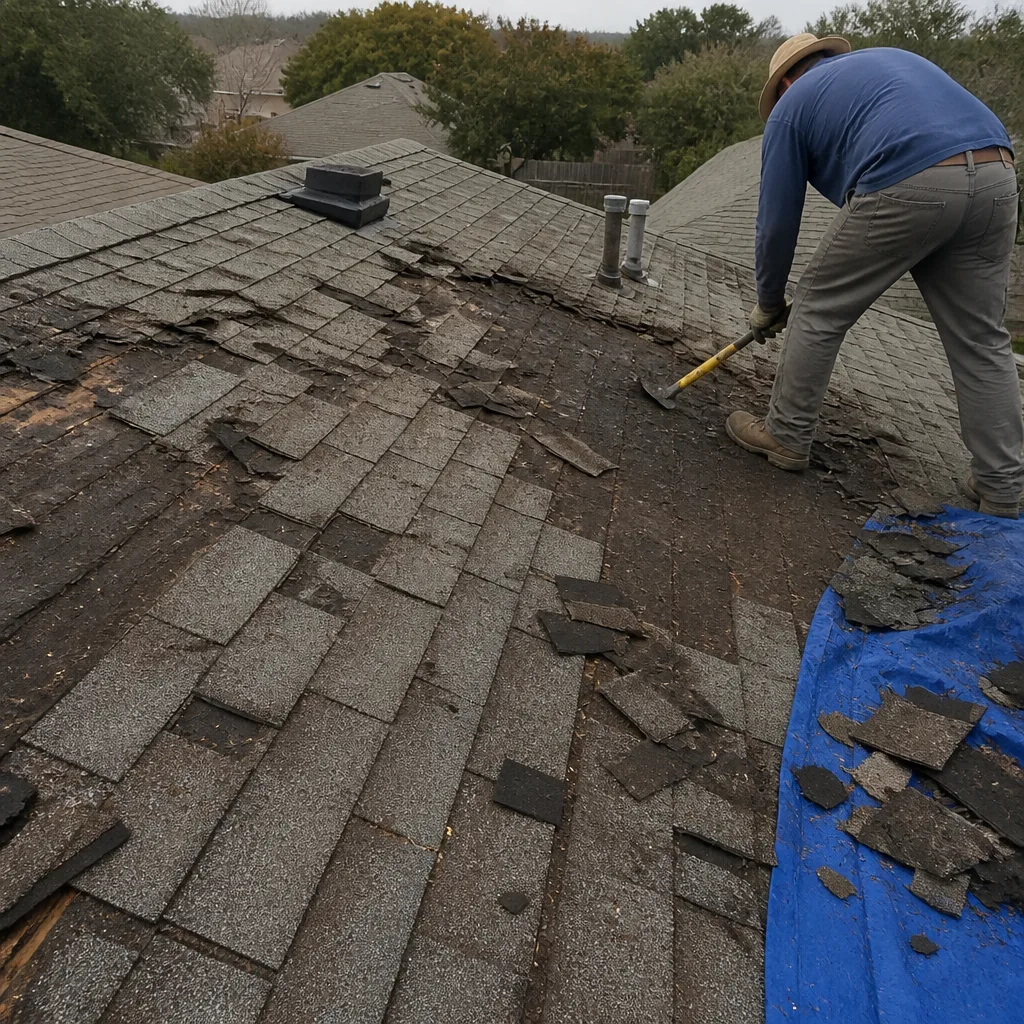 Before
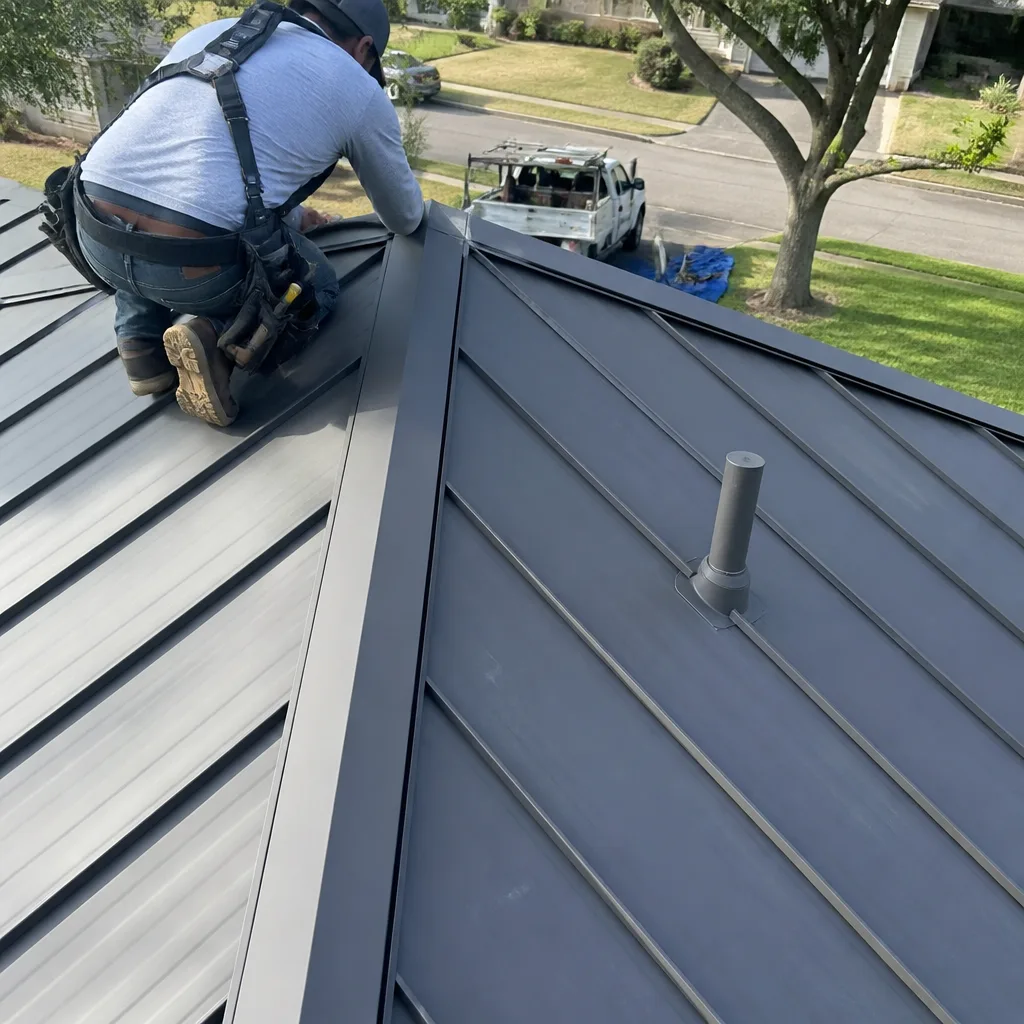 After
After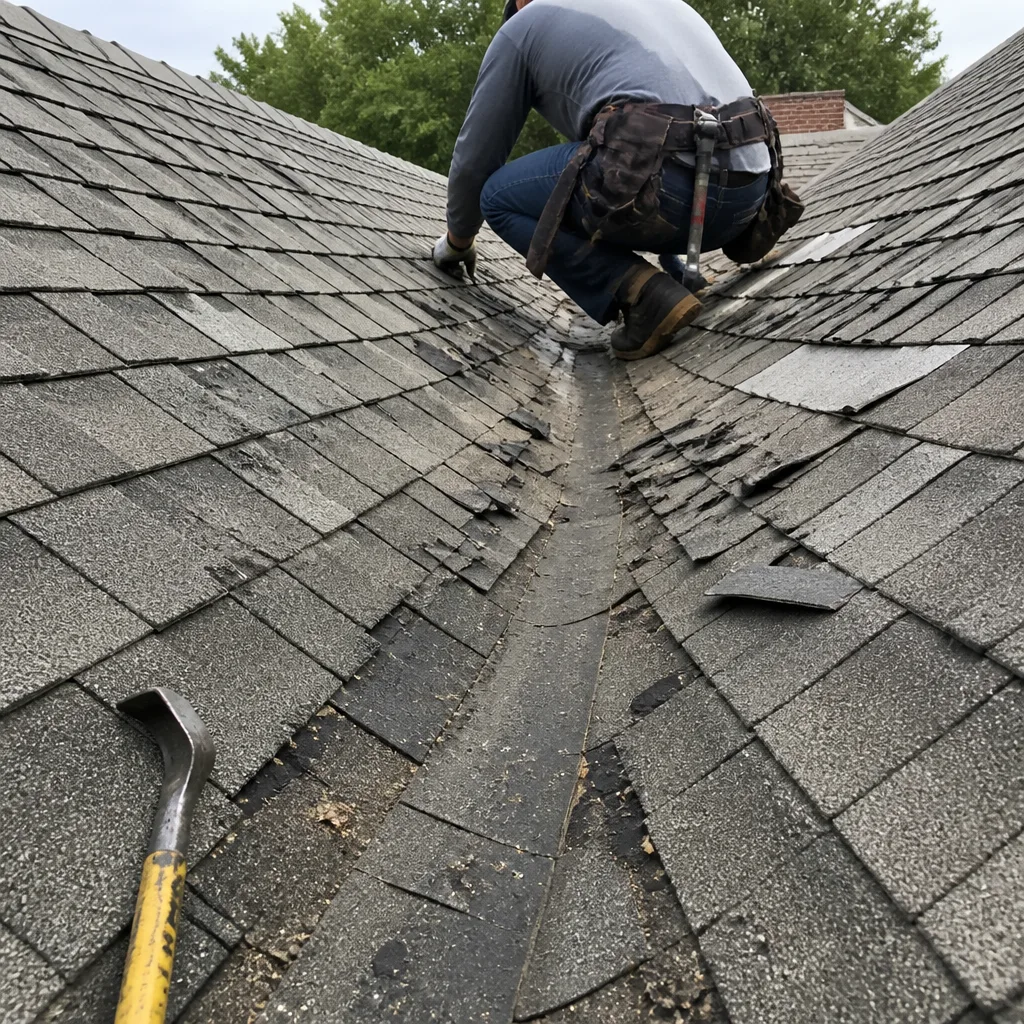 Before
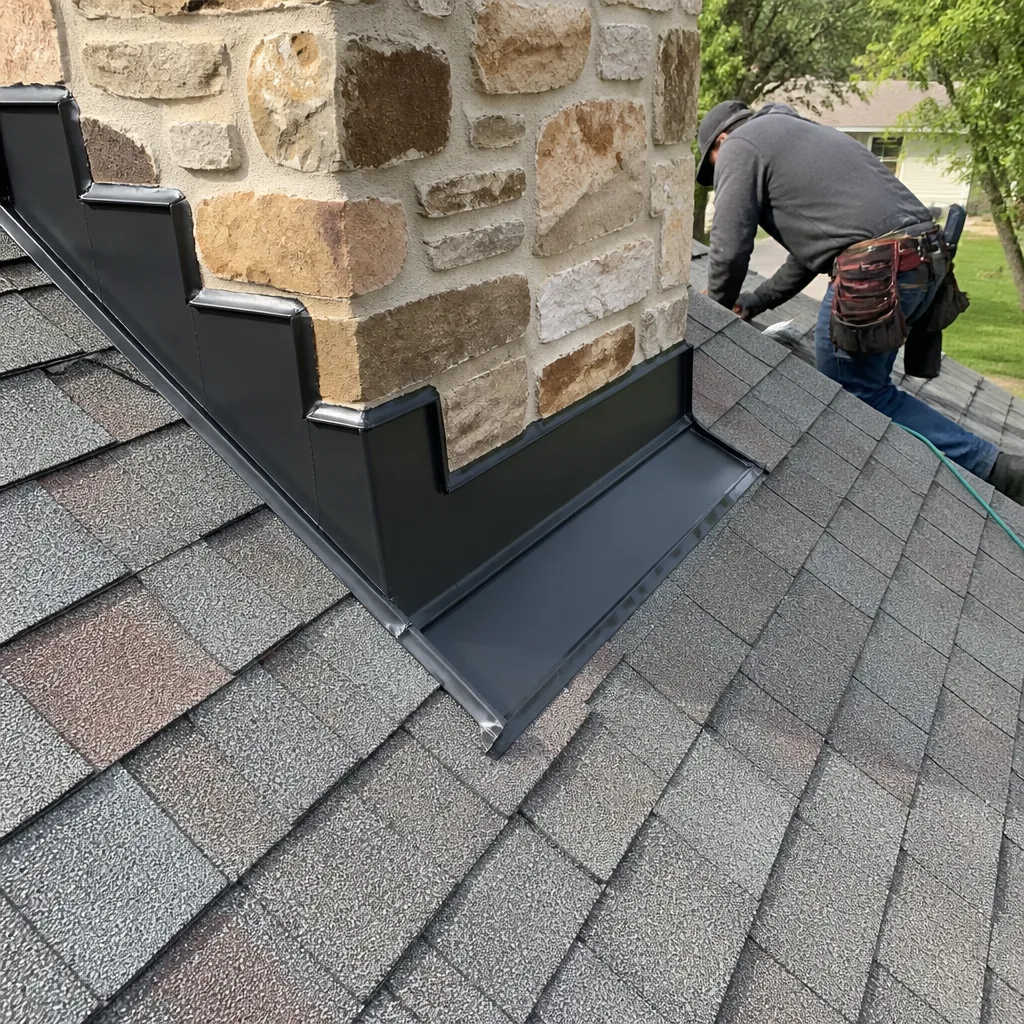 After
AfterFrequently Asked Questions
A roof leak stain is usually a defined ring or patch that grows after rain, while a condensation stain is broad, faint, and does not change with weather. Mark the stain outline with a pencil and check it after the next hard Dallas rain. If it grows, call a roofer. If it stays put through three rain events, look at attic ventilation before you look at the roof. Call (903) 499-4441 for an exact diagnosis.
Minor flashing and pipe boot repairs in Dallas typically run $150 to $900. Leaks that have been active long enough to damage decking, insulation, and drywall run $1,500 to $4,000 and up. The range depends on how long the leak has been active. Call (903) 499-4441 for a written quote after we see the attic and the roof.
Not always. Hail damage that is localized to one plane may be repairable, and the insurance adjuster and roofer should document the scope before any work starts. What makes the difference is functional damage found during a post-storm attic inspection, because that damage may not be visible from the ground. If hail larger than a quarter has fallen on your neighborhood, get the attic checked.
Twice a year is advisable in Dallas, once in spring and once in fall, plus after any significant hail or wind event. The heat and UV here accelerate shingle and sealant aging, and the spring hailstorm season makes post-storm checks the most cost-effective inspection you can schedule.
Not if you are working with a roofer who puts the price in writing before any work starts. That is the Garrison Standard at Brennan Roofing Co Dallas home and it is the way Travis Oakley runs every job. If a roofer will not put the number on paper, find another roofer.
Architectural asphalt shingles in Dallas typically last 15 to 25 years depending on the manufacturer line, the ventilation, the roof pitch, and the sun exposure. GAF and CertainTeed architectural lines installed with proper ventilation routinely hit the high end of that range here. Poor ventilation and south-facing planes with heavy UV exposure compress it.
The Bottom Line
Roof warning signs in Dallas demand triage, not panic. An active leak is urgent. Missing shingles and open flashing have a 30-day clock. Granule loss and hairline cracks are watchable. The difference between a $400 repair and a $4,000 repair is almost always time: how long a small failure has been allowed to run. If you are in Dallas and you have a question about your roof, call Roof Repair in Dallas at (903) 499-4441. We will look at the roof, tell you the truth about what we find, and put the price in writing before any work starts. That is the Garrison Standard, in every neighborhood we serve.
Written by Travis Oakley, Owner at Brennan Roofing Co Dallas, serving Dallas since 2000. Browse more guides & resources on our blog.